
Winter challenge - icing on offshore wind turbines
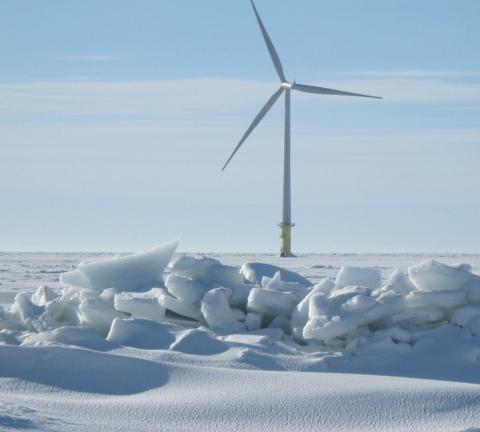
Icing on wind turbines occurs when supercooled water droplets or liquid water droplets freeze rapidly on contact with a sub-zero surface (below 0°C) on the turbines.
Icing can also occur when rain and snow mixed falls over a wind farm and is followed by sub-zero temperatures, as the melted slushy snow sticks on the turbines and then freezes into ice.
Types of icing
Following weather phenomenon generate icing:
- Freezing fog and low clouds: These cause icing as supercooled water droplets in low clouds or freezing fog move across an offshore wind farm where the small, supercooled water droplets stick on the wind turbines.
- Freezing rain/drizzle: These cause icing as both are liquid precipitation that fall onto the surfaces on the wind turbines that have temperatures below 0°C, causing them to freeze on contact. The key difference is that freezing rain starts as snow that melts into rain as it falls through a warm layer of air before passing through a shallow, sub-freezing layer near the surface.
Freezing drizzle forms in shallow, low-level clouds where supercooled water droplets coalesce into a size large enough to fall but remain liquid until they hit a sub-freezing surface. - Snow and snow and rain mixed: Icing can occur when rain and snow mixed falls and is followed by sub-zero temperatures, as the melted slushy snow sticks on the turbines and then freezes into ice. Snow may also cause icing as snow in sub-zero temperatures might melt on the turbines, due to heat formed by the rotor mechanics, causing icing.
- Freezing sea-spray: This causes icing as droplets of seawater freeze upon contact with surfaces on the wind turbines. It is caused by waves splashing or winds blowing water off wave crests, creating water droplets that can be carried up to high altitudes by the wind where they are stuck on the lower parts of the wind turbines. It requires winds of at least 12-15 m/s and air temperatures that are below the freezing point of sea water depending on the amount of salinity in the water. You can read more on freezing sea spray here.
Rime ice or clear ice
Icing can mainly be divided into rime icing and clear icing.
Rime ice forms when very small, supercooled droplets freeze and air bubbles get trapped giving the ice a white appearance. This is common in connection with freezing fog.
Clear ice forms as bigger supercooled water droplets spread over a surface before they freeze, forming a more transparent look. This is common in connection with freezing rain. A mix of these too is also possible when there are different sizes of supercooled water droplets present.
Safety measures
Icing will cause a build-up of ice on the wind turbines which will be dangerous due to ice-throw and falling ice as well as slipping on ice. At Vento Maritime. Duty forecaster evaluates and actively monitors the risk of icing on wind turbines in offshore wind farms to raise the safety for personnel working on the farms. When icing is predicted to occur then alerts are being sent by the meteorologist in charge.
The challenge of icing on offshore wind turbines underscores the importance of proactive monitoring and innovative solutions. As renewable energy continues to expand, ensuring the reliability and safety of wind farms - especially in harsh winter conditions - remains a priority. Meteorologists play a crucial role in forecasting icing events, allowing operators to take preventive measures such as temporarily not accessing the turbines for maintenance, shutting down turbines, deploying heating systems, or applying ice-phobic coatings to minimize ice accumulation.
Addressing icing challenges is not just about safeguarding personnel and infrastructure; it’s about ensuring the steady flow of clean energy, even in the face of nature’s most formidable conditions.