
The Douglas Sea Scale

Calm conditions, moderate conditions, rough conditions…
Probably, you have heard these phrases a couple of times, but what are they, and what do these phrases correspond to?
This article links these phrases to a significant wave height.
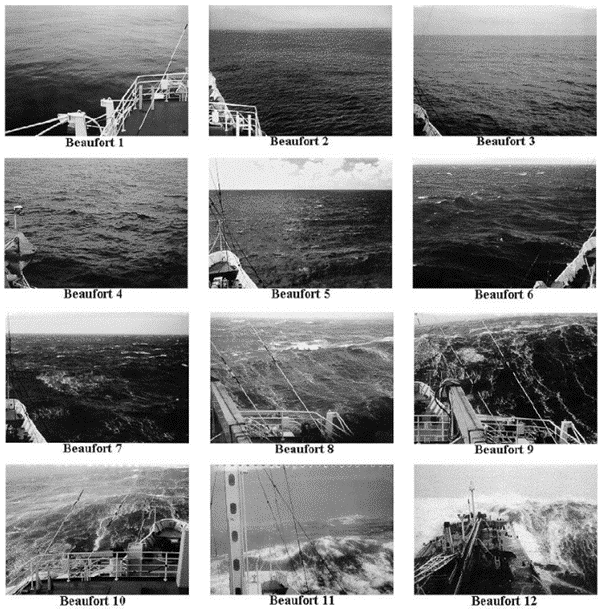
When we talk about the wind speed, we can speak in terms of for example knots or meters per second. But we can also classify the wind speed in terms of Beaufort, which relates a specific wind speed to observed conditions. The Beaufort Scale is ranging from 0Bf, meaning “Calm” and wind speed below 1 knot, and to 12Bf, which is wind speed of Hurricane-force (64 knots or more). In below figure there is a photo for every sea state from 1BF to 12Bf.
When we talk about the significant wave height, we can speak in terms of meters or feet. But also, for this parameter we can use a specific scale, called the Douglas Sea Scale which is divided into ten different degrees. This scale estimates the roughness of the sea with respect to both the sea state and the swells. The Douglas Sea Scale was created in 1921 by Captain, and later vice admiral Sir, Henry Percy Douglas. He was an Englishman who, among other things, became hydrographer of the Royal Navy and thanks to him, we have this scale that ever since has been used in operational weather services. His scale is displayed in below figure.
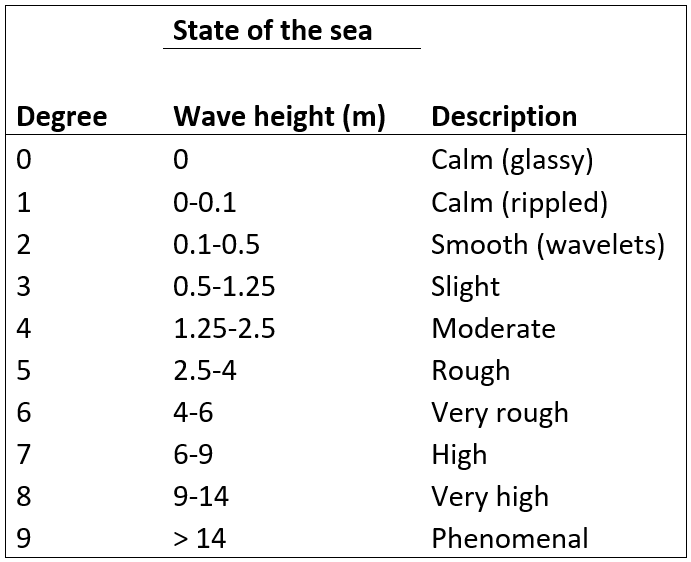
So back to the terms, “calm”, “moderate” and “rough” conditions. They can be used as relative terms, i.e., if you are used to a significant wave height of 4m Hs, then 1m Hs could be considered rather calm compared to that. But, not according to the Douglas Sea Scale! In matter of fact, calm conditions (or degree 0 or 1) only apply to wave heights of up to 0.1m Hs! With higher waves than that, we call it “smooth”, followed by “slight”, “moderate”, “rough”, and some more. An overview of the 10 degrees, regarding the state of the sea (of wind waves) is structured in the tables below (adapted from World Meteorological Organization).
Autumn and later winter are periods which, among other things, are characterized by gradually more ”rough” conditions. However, we do experience waves of significant heights also during the summers, especially during storms and hurricanes. Hurricane Ivan, who churned through the Caribbean Sea and the Gulf of Mexico in September 2004, caused the significant wave height to rose to at least 52 feet, or almost 16m. Talk about phenomenal conditions!
In the world of meteorology and maritime operations, the Douglas Sea Scale remains a valuable tool for gauging and communicating the state of the sea. Whether it's for the safety of seafarers, the precision of weather forecasting, or simply a better understanding of our dynamic planet, this scale continues to play a vital role in our maritime endeavors.